
PV-BESS Hybrid Analysis
Overview
Glint's latest Hybrid Analysis allows you to model the performance of a combined PV + BESS plant over its full operational lifetime.
Why is this important for you during development phase? For standalone PV projects, solar yield modelling alone allowed you to get an early sense of project viability. Adding batteries introduces additional complexity. Revenue depends not only on energy production, but also on how battery storage is operated, including peak shaving and arbitrage strategies.
Analyse your PV-BESS project in Glint, and get an early revenue estimate, that you can use to compare viability across different scenarios of one project, or across your portfolio.
You can also export the full results of our simulation to use in your own tools, if you prefer.
How to use this feature?
- Start off with a design containing both BESS and PV areas
- Start a new Analysis
- Make sure your irradiation source is Automatic - TMY (or another TMY source)
- Make sure you set the Grid Limit of your project. For the analysis to make sense, the grid limit should be less than your PV inverter power (i.e. there has to be curtailed PV energy)
- To set up your BESS dispatching rules, go to BESS dispatching, under the BESS settings
- Use the toggles as follows:
- Import from PV - Your batteries will be charged from curtailed PV energy
- Import from Grid - Your batteries will be charged from the grid. This setting should be used together with the Arbitrage option
- Optimize for revenue: With this option on, the simulation algorithm will take into account market prices. We will also be able to give you an estimation of how much more revenue your site will generate thanks to hybridization.
Understanding Your Results
Energy Timeseries
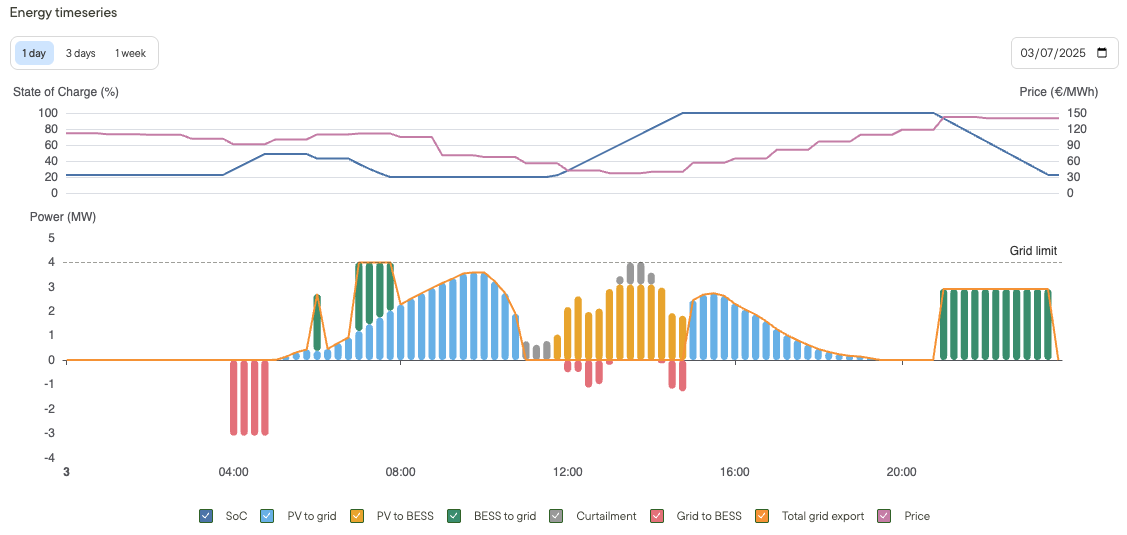
This graph shows how your system behaves over time based on the optimization algorithm. Use it to understand when and how energy flows through your system.
What you'll see:
- PV to Grid: Solar energy exported directly to the grid
- PV to BESS: Solar energy stored in batteries
- BESS to Grid: Battery energy discharged to the grid
- SoC (State of Charge): Battery charge level throughout the day
- Grid Limit: Your maximum export capacity (shown as a reference line)
- Price: Electricity prices over time (when arbitrage is enabled)
Revenue Graphs
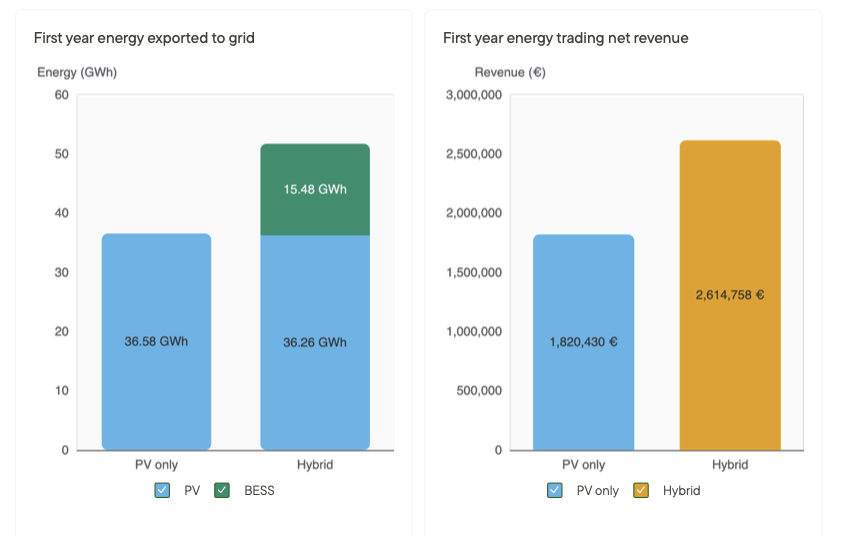
These graphs help you assess the impact of adding BESS to your PV site by comparing scenarios.
Grid Utilization Graphs
Grid connection utilisation
Weekly-averaged % of your grid capacity actually used, plotted for both scenarios. A battery significantly increases grid utilisation. This is important for demonstrating that you're using your grid connection efficiently.
Import / export heatmap
Net grid flows by hour of day and month of year. Green = net export, red = net import. Reveals seasonal and daily dispatch patterns at a glance, and is a quick sanity check that the battery is behaving as expected.
Different Analysis Scenarios
1. Full fledged hybrid optimization with arbitrage
Your batteries will charge from the grid, and from curtailed PV production. Glint runs an optimization using linear programming, where we take into account the grid limit, historical spot prices from the past year, the characteristics of your PV system, your BESS system. The optimization algorithm maximizes revenue.
How to run this analysis? Import from PV = On, Import from Grid = On, Optimize for Revenue = On
2. Green Energy Storage with prices
Your batteries will only charge from curtailed PV production. Glint runs an optimization using linear programming, where we take into your grid limit and the characteristics of your PV system, maximizes revenue.
How to run this analysis? Import from PV = On, Import from Grid = Off, Optimize for Revenue = On
3. Green Energy Storage without prices
Your batteries will charge from curtailed PV production. Glint runs an optimization using linear programming, where we take into your grid limit and the characteristics of your PV system. The optimization maximizes output to the Grid.
How to run this analysis? Import from PV = On, Import from Grid = Off, Optimize for Revenue = Off
4. BESS arbitrage only
PV and BESS don’t interact. Can be used on BESS-only projects. Glint runs an optimization using linear programming, where we take into account historical spot prices from the past year, the characteristics of your BESS system, and maximize revenue.
How to run this analysis? Import from PV = Off, Import from Grid = On, Optimize for Revenue = On
Frequently asked questions
- Do you assume the system is AC-coupled or DC-coupled? For now, we assume AC-coupled. We might support DC-coupled in the future.
- Where are the prices from? Historical day-ahead spot prices from the most recent full year, scaled year-on-year by the escalation rate you set.
- Is the arbitrage option supported in my country? We currently support prices for the following markets: Austria, Australia, Belgium, Germany, Denmark, Spain, Finland, France, UK, Greece, Ireland, Italy, Netherlands, Norway, Poland, Portugal, Romania, Sweden
- I ran a Green Storage analysis but can't see any results, please help? Check that you have indeed toggled on Import from PV, and set a Grid Limit that is inferior to your solar inverter power.
- Can I use my own forecasted prices? Not yet - but it's something we're building towards. If you're interested in this, we'd love to hear more from you.