
'Automatic' irradiance source - SARAH 2.1 vs. SARAH 3.0
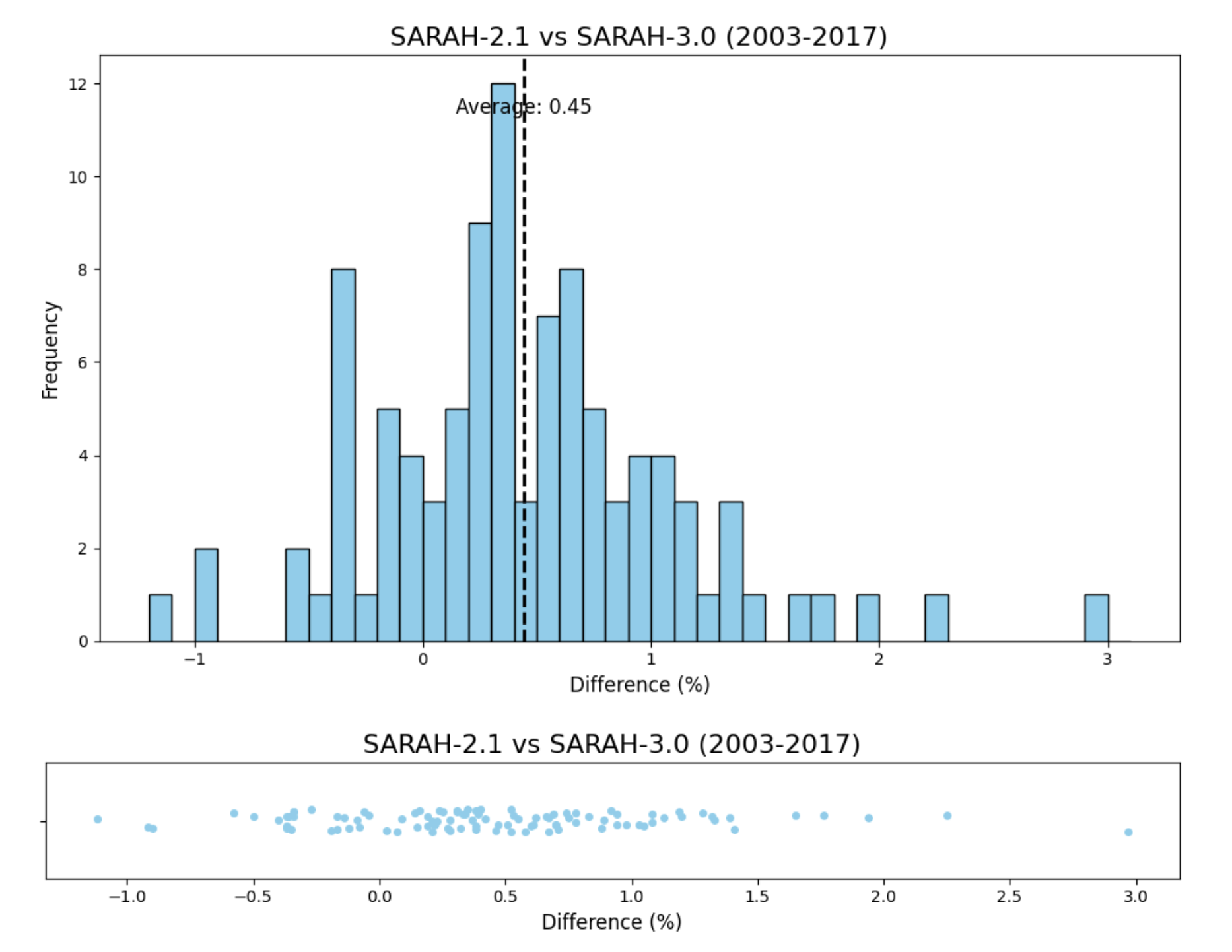
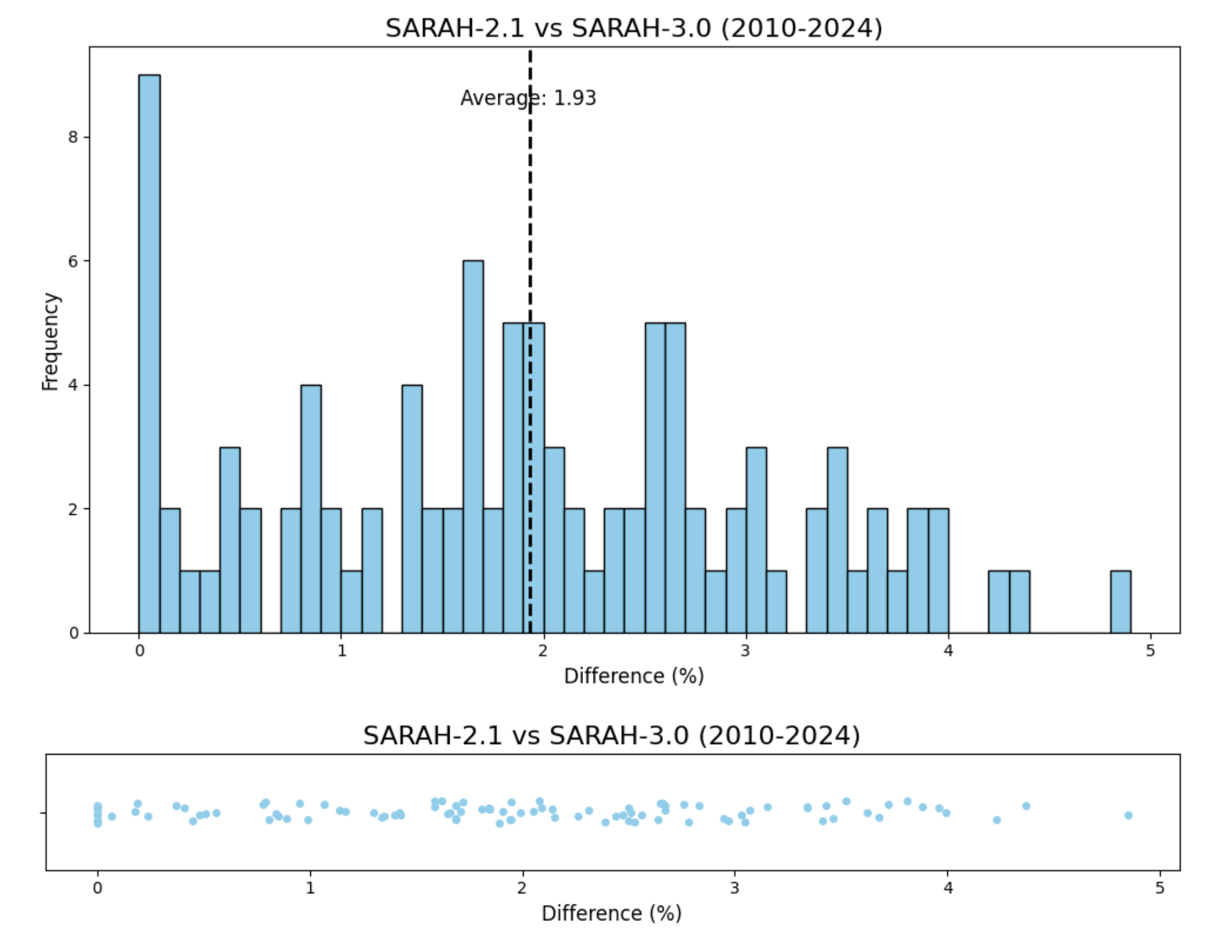
We upgraded our irradiance data source in July 2025 from SARAH 2.1 to SARAH 3.0. This means your projects will get an upgrade as well! We've compared 30 different typical project locations across Europe and Africa and compiled the results here. On average, you will see and increase of approximately 2% in yield results!
SARAH 2.1 vs. SARAH 3.0
Comparison of the datasets
SARAH-2.1
- provides data from 1983 to 2017
- spatial resolution 0.05°x 0.05°
- temporal resolution 30 minutes
- provides:
- direct normalized irradiance (DNI)
- surface incoming direct radiation (SID)
- surface incoming shortwave radiation (SIS)
- sunshine duration (SDU)
- spectral resolved irradiance (SRI)
SARAH-3.0
- provides data from 1983 to 2024
- spatial resolution 0.05°x 0.05°
- temporal resolution 30 minutes
- improved accuracy, stability, and solar radiation estimation, mainly due to a new treatment of snow-covered
surfaces in the algorithm, reducing the misclassification of snow as clouds - provides:
- direct normalized irradiance (DNI)
- surface incoming direct radiation (SID)
- surface incoming shortwave radiation (SIS)
- sunshine duration (SDU)
- daylight (DAL)
- photosynthetic active radiation (PAR)
Notes:
- we only use data from 1995 to 2024
- we only use DNI and SIS (GHI)
Differences in yield using SARAH-2.1 (2003-2017) vs SARAH-3.0 (2003-2017)
Differences in yield using SARAH-2.1 (2003-2017) vs SARAH-3.0 (2010-2024)
Additional resources
For more information on configuring your PV settings in Glint Solar, see Adjusting the PV configuration
Learn more about the technical concepts described above in the Solar Site Planning Guide:
For information on losses recorded in Glint Solar and how those losses are recorded in PVsyst, see Losses in Glint vs. losses in PVsyst.