
BESS Operations
A Battery Energy Storage System (BESS) operates by charging and discharging to generate revenue, either by providing services to the grid, such as frequency regulation, energy arbitrage, peak shaving, or demand charge management, or by integrating with renewable energy sources to improve capture rates (sales price of energy generated) or improve utilization of the grid connection. Operations are controlled automatically, almost always remotely, as defined by the local regulations for the specific services monetized. The efficiency, longevity, and profitability of a BESS depend on several key operational metrics.
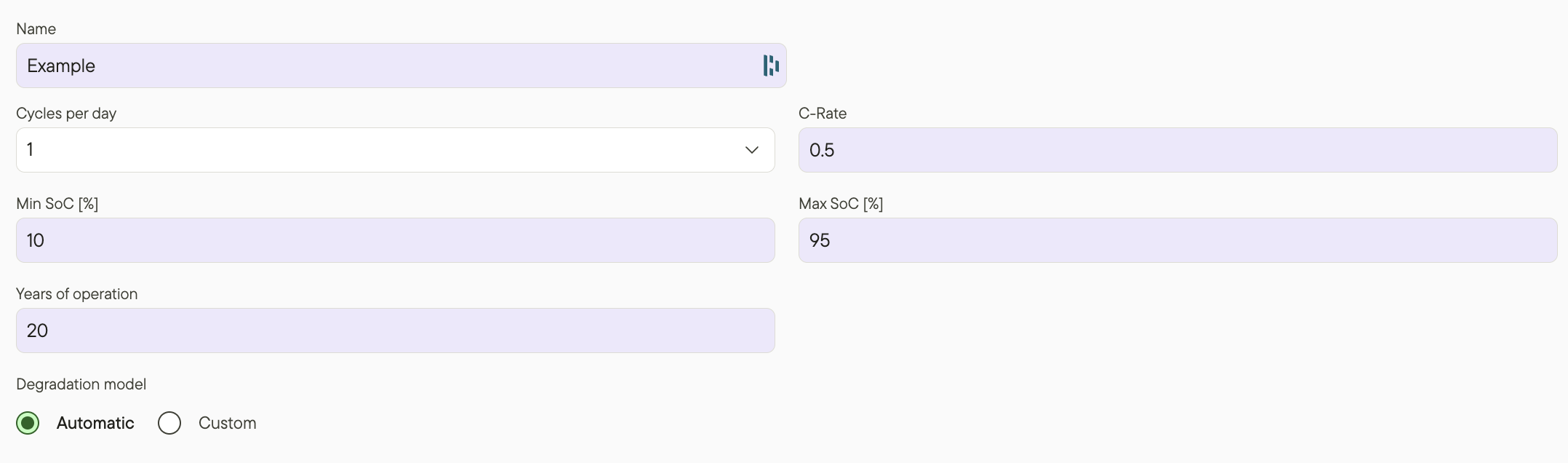
When setting up an operations profile, several factors must be defined (the values below are illustrative):
Cycles per day
Cycles per day represent the number of complete charge and discharge cycles a battery undergoes in a 24-hour period. A cycle is defined as the total energy charged and discharged equivalent to the full available capacity of the battery while adhering to minimum and maximum state-of-charge (SoC) limitations. More cycles per day can lead to increased revenue potential but may also accelerate battery degradation.
C-rate
C-rate, or charge rate, is the maximum sustained rate of charge or discharge, represented as a ratio of the battery’s capacity divided by its maximum sustained rate of charge. A battery with 0.5C can fully charge in 2 hours, whereas a battery with 1C can fully charge in 1 hour. In Glint Solar it is assumed that charge rates and discharge rates are the same.
Higher C-rates enable faster response times but may contribute to increased thermal stress and accelerated degradation. The maximum C-rate varies by battery chemistry, cooling equipment, and manufacturer specifications.
Min SoC
Minimum SoC, or state-of-charge, is the lowest recommended charge level as defined by the manufacturer’s warranty. Typically ranging from 5% to 20%, the minimum SoC is designed to protect battery cells and minimize degradation. Prolonged operation below this threshold can lead to increased stress on battery chemistry, reducing overall lifespan and efficiency.
Max SoC
Maximum SoC is the highest recommended charge level as defined by the warranty, often between 90% and 95%. Maintaining a battery at a high SoC for extended periods accelerates chemical degradation, reducing overall system longevity. The difference between the minimum and maximum SoC is known as the depth of discharge (DoD) and represents the usable energy capacity of the battery.
Years of operation
Years of operation refer to the expected calendar lifetime of a BESS, typically dictated by the manufacturer’s warranty and operating conditions. Standard lifespans range from 8 to 20+ years, depending on battery chemistry, usage patterns, and maintenance practices. BESS longevity can be extended through:
Augmentation: Adding new battery modules over time to compensate for capacity loss.
Repowering: Replacing aging battery cells and associated infrastructure to extend operational life.
Thermal management and optimized cycling: Maintaining optimal operating temperatures and minimizing extreme charge/discharge cycles to reduce stress on battery components.
Degradation (auto/custom)
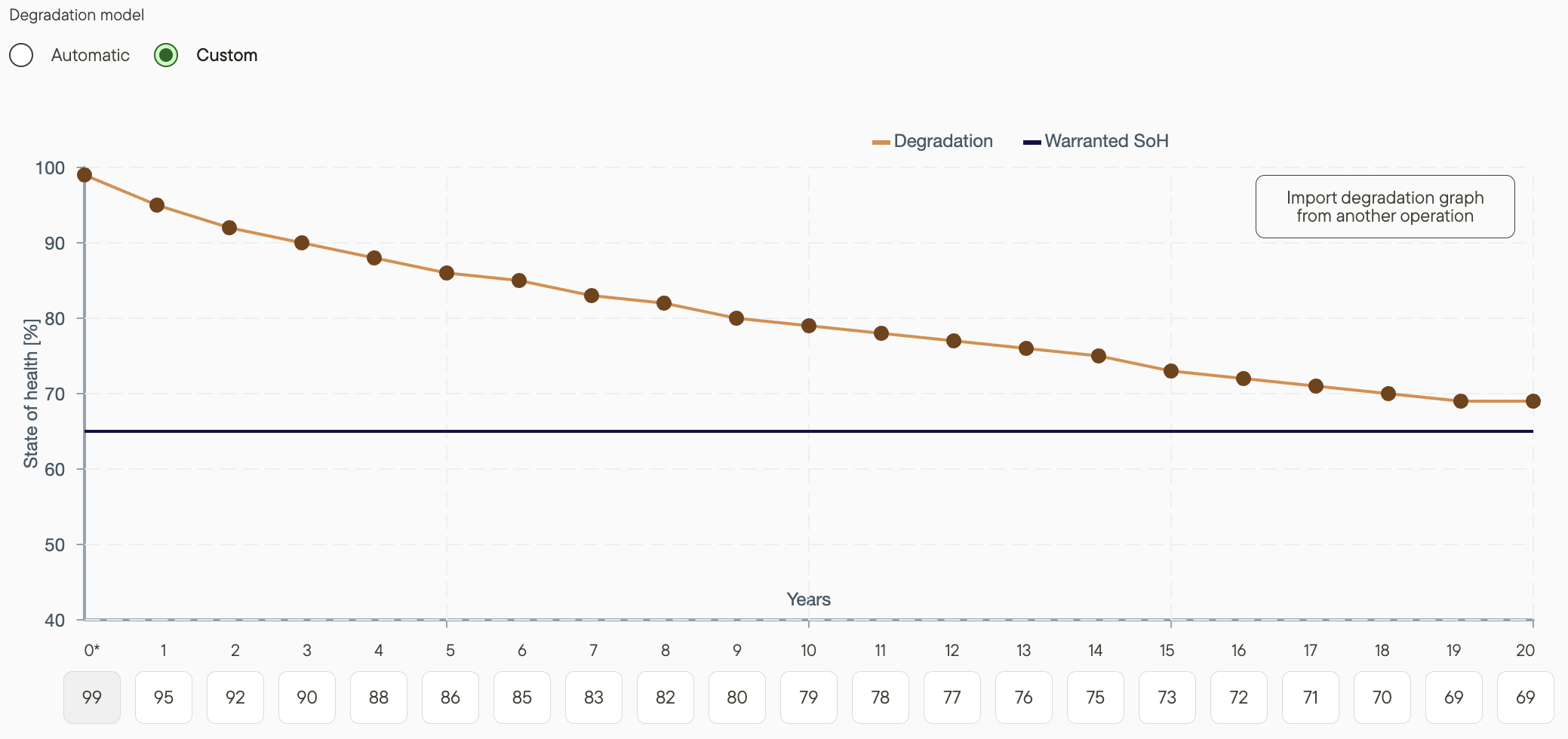
Finally, degradation must be taken intro account. All stationary energy storage systems experience degradation, which is the gradual reduction in capacity over time due to operational and environmental factors. Degradation is influenced by many factors including cycle degradation (number of charge-discharge cycles), shelf, or calendar degradation (the time the battery exists, independent of operations), and extreme conditions such as high or low temperatures, rapid cycling, and high C-rates. The amount of degradation can be expressed as a percentage as State-of-Health (SoH), representing the total capacity available vs. the nominal capacity available at delivery.
Our tool provides an automatic degradation model that accounts for standard degradation patterns and the other factors defined in operation. Glint solar includes shelf degradation when accounting for initial capacity available. Users can also input a custom degradation curve based on manufacturer specifications for performance modeling more accurate for the specific equipment chosen. For the customer degradation curve, users can enter state-of-health (SoH) percentages directly, click and drag values on the curve, or import a degradation curve from another project. These custom user-defined degradation curves must be aligned with the other factors defined in operation (such as C-rate) to be accurate.
Additional resources
For more detail on BESS configuration, please see the articles below: